

Home backup generators
Updated 13 November 2026
A home backup generator keeps your fridge, boiler, lights and Wi-Fi running in a power cut. For the essentials, a 3 kW LPG generator is usually enough. For the whole house, choose 5 to 9 kW. Auto-start models switch on by themselves when the power fails. A qualified electrician must connect any of them to your home.



LPG/Petrol Generator GB8000HL 7.5kVA Honda GX390 Dual Fuel
£1,604.00 inc VAT · free delivery over £200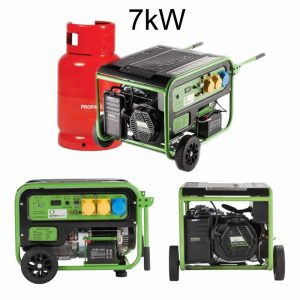


LPG Generator 12.5kVA GB12000HL AS Auto-Start Honda GX690
£4,421.00 inc VAT · free delivery over £200Home backup generators compared
Every generator below runs on LPG (propane), which stores for years without going off. Prices include VAT.
| Generator | Start | Fuel | Continuous power | Price | Stock |
|---|---|---|---|---|---|
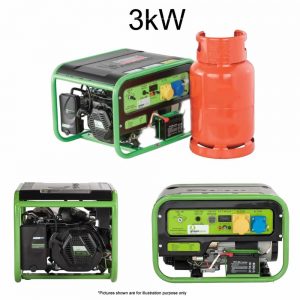
| Greengear 3kW | Electric start | LPG | 2,800 W | £662 | In stock |
| Greengear 5kW | Electric start | LPG | 5,000 W | £949 | In stock |
| Gear GB GB8000HL | Pull cord | LPG or petrol | 5,200 W | £1,604 | In stock |
| Greengear 7kW | Electric start | LPG | 7,000 W | £1,249 | In stock |
| Gear GB GB5000HL AS | Automatic | LPG | 3,500 W | £2,633 | In stock |
| Gear GB GB8000HL AS | Automatic | LPG | 5,000 W | £2,897 | In stock |
| Gear GB GB12000VL AS | Automatic | LPG | 9,000 W | £3,319 | In stock |
| Gear GB GB12000HL AS | Automatic | LPG | 9,000 W | £4,421 | In stock |
What size generator do I need for my home?
Add up what you want to keep running at the same time. These are typical running figures:
- Fridge-freezer: 100 to 200 W (more for a few seconds when it starts)
- Gas boiler controls and pump: 100 to 200 W
- LED lights: about 10 W each
- Wi-Fi router and phone chargers: under 50 W
- Kettle: 2,000 to 3,000 W
- Microwave: about 1,000 to 1,500 W
The essentials come to well under 1,000 W, so a Greengear 3kW covers them with room to spare. To boil a kettle as well, step up to the Greengear 5kW. Electric showers and immersion heaters use 3,000 to 10,000 W on their own, so leave them off. Check your own appliances with the generator size calculator.
Manual or auto-start?
Manual generators (the Greengear range and the GB8000HL) are the lower-cost choice. When the power goes off, you start the generator and flip the changeover switch. The Greengears have an electric start button.
Auto-start generators (the Gear GB AS models) start themselves within moments of a power cut and stop when the mains comes back. They need an automatic mains failure (AMF) panel, fitted by an electrician. Choose auto-start if someone in the home relies on power, or if you are often away.
How do I connect a generator to my house safely?
- Get a changeover switch fitted. A qualified electrician installs it next to your consumer unit. It stops the generator feeding power back into the mains.
- Run the generator outside. Generators make carbon monoxide, which can kill. Never run one in a house, garage or shed.
- Store the gas outside. Keep LPG cylinders upright, outdoors, and away from drains and doorways.
Why LPG for home backup?
Petrol starts to go stale within a few months, so a petrol generator kept for emergencies may not start when you need it. Propane does not go off. A cylinder can sit outside for years and still be ready. LPG also burns cleaner, so the engine stays cleaner between uses. Read more in our house generator buying guide, or see quiet generators if noise matters to your neighbours.
Home backup generator questions
What size generator do I need to back up my house?
For the essentials (fridge-freezer, boiler, lights and Wi-Fi) a 3 kW generator is usually enough. To run a kettle or microwave as well, choose 5 to 7 kW. Add up your own appliances with our generator size calculator.
Can I plug a generator into a socket in my house?
No. Never connect a generator to a household socket. It can send power back into the mains cable and put engineers working on the line at risk. A qualified electrician must fit a changeover switch so the generator can power your circuits safely.
Why choose LPG for a backup generator?
Propane does not go stale in storage, while petrol starts to go off within a few months. So a cylinder kept outside is ready to use whenever the power goes off, even if the generator has sat unused for a year.
How long will a gas cylinder last in a power cut?
A Greengear 5kW uses about 19 kg of propane in 21 hours, so a 19 kg cylinder runs it for most of a day. A 47 kg cylinder lasts more than two days. Lighter loads use less gas.
What is an auto-start generator?
An auto-start generator starts itself when the mains power fails and stops when it comes back. The Gear GB AS models do this when they are wired to an automatic mains failure (AMF) panel, which an electrician fits.