Choosing the Ideal Coffee Machine for Mobile Catering: A Comprehensive Guide


Setting up a mobile catering business, especially one focused on coffee, means you need equipment that can keep up with demand, even when you’re on the move. Choosing the right coffee machine for mobile catering isn’t just about making a good cup of coffee; it’s about reliability, speed, and fitting into a potentially tight space. This guide will walk you through what to think about when selecting a coffee machine for your mobile setup, from understanding your specific needs to the practicalities of power and maintenance.
Key Takeaways
-
Assess your business scale, menu, and available power before choosing a coffee machine for mobile catering.
-
Prioritise brewing capacity, speed, durability, and ease of use in your mobile catering coffee machine.
-
Consider espresso machines for specialty drinks, drip coffee makers for volume, and pod systems for convenience.
-
Understand generator needs, LPG options, and water/waste management for powering your mobile coffee operation.
-
Don’t forget essential extras like grinders, water filters, and reliable suppliers for a smooth operation.
Understanding Your Mobile Catering Coffee Machine Needs
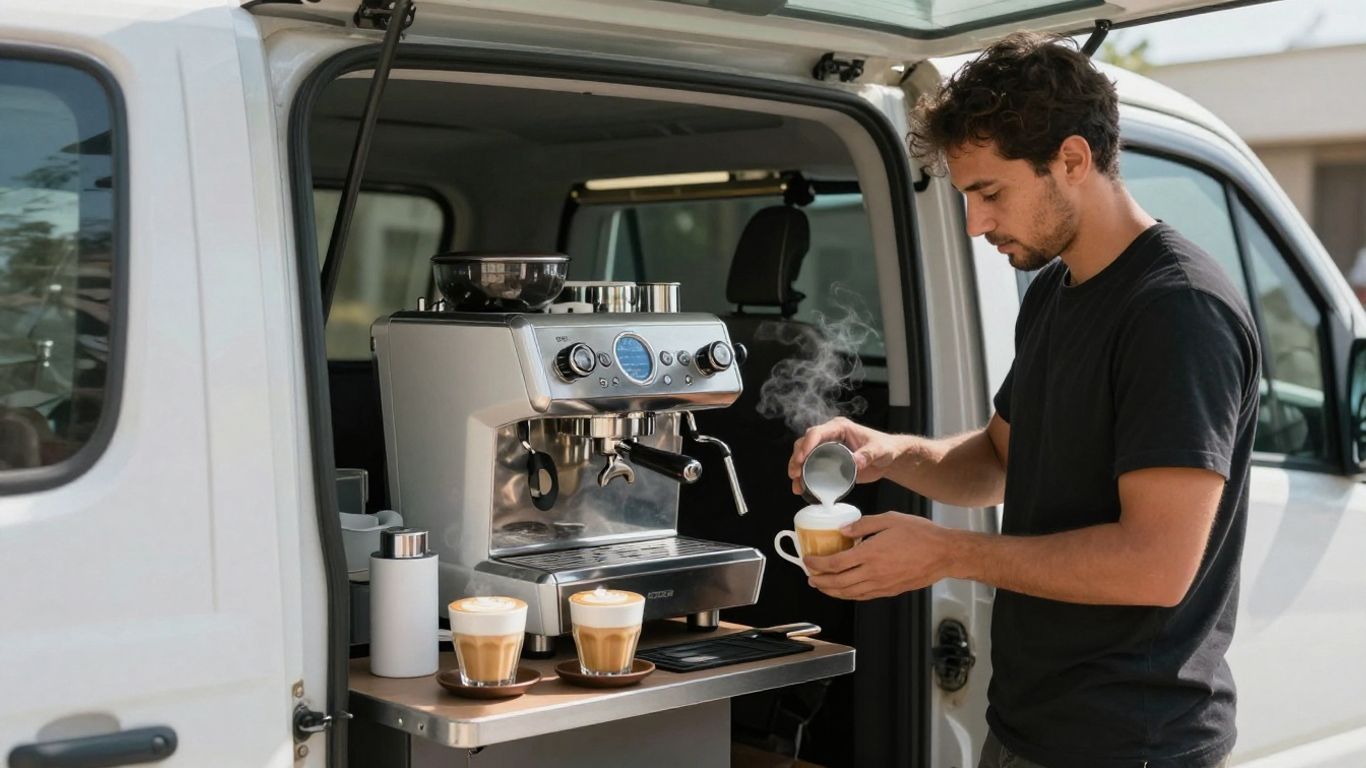
Right then, before you go buying the flashiest espresso machine you can find, let’s have a think about what you actually need. It’s not just about making a decent cuppa; it’s about making it work for your business on the move.
Assessing Your Business Scale and Customer Volume
How many people are you expecting to serve? This is the big one. If you’re at a small village fete, you won’t need the same kit as someone at a major music festival.
-
Small Events (Under 50 customers/hour): A simpler, smaller machine might do the trick. Think about speed, but don’t overspend on capacity you won’t use.
-
Medium Events (50-150 customers/hour): You’ll need something a bit more robust. Look for machines that can handle a steady flow without slowing down.
-
Large Events (150+ customers/hour): This is where you need serious power. Think commercial-grade machines that can churn out drinks quickly and reliably.
Don’t guess your numbers; try to get a realistic idea of peak times. It’s better to have a machine that’s slightly too big than one that’s constantly struggling.
Considering Your Menu and Drink Offerings
What are you actually going to sell? Just filter coffee, or fancy lattes and cappuccinos? This makes a huge difference to the machine you’ll need.
-
Espresso-based drinks (Lattes, Cappuccinos): You’ll need a proper espresso machine with a good steam wand. This means more power and more complexity.
-
Filter Coffee: A good quality drip coffee maker is simpler and can produce larger volumes, but it’s less versatile.
-
Specialty Drinks: If you’re planning on things like cold brew or unique concoctions, you might need additional equipment or a machine with specific features.
Think about milk alternatives too. Steaming alternative milks can sometimes be trickier, so check if your chosen machine handles them well.
Evaluating Your Available Space and Power Sources
This is where the ‘mobile’ part really comes in. Your catering van or trailer has limits.
-
Size: Measure up! Make sure the machine fits comfortably in your workspace. You need room to operate it, clean it, and get around it.
-
Power: What’s your power source? A generator? Mains hook-up? Some machines are power-hungry. Check the wattage and make sure your power supply can handle it. A generator that’s too small will just cut out, leaving you with unhappy customers.
Always double-check the power requirements for any machine you’re considering. It’s a common pitfall to buy a great machine only to find your generator can’t cope, or it takes up too much precious counter space.
Safety is key here. Make sure all electrical connections are sound and that your generator is properly maintained and used according to its instructions. You don’t want any electrical mishaps when you’re trying to serve coffee.
Key Features for a Mobile Catering Coffee Machine
Brewing Capacity and Speed
When you’re serving a queue of customers, speed is everything. You need a machine that can keep up. Look for models that can brew multiple cups or shots quickly. This means less waiting for customers and more sales for you.
-
High throughput: Aim for machines that can produce at least 100 cups per hour.
-
Fast heat-up time: A machine ready to go in minutes saves precious time.
-
Consistent output: Ensure the quality doesn’t drop when brewing back-to-back.
Consider a machine with a decent-sized water reservoir to avoid constant refilling during busy periods. This is a real time-saver.
Durability and Build Quality
Mobile catering means your equipment gets a workout. It’s bumped, moved, and often exposed to different conditions. A robust build is non-negotiable.
-
Stainless steel construction: This is tough and easy to wipe down.
-
Solid internal components: Cheaper machines might use plastic parts that break easily.
-
Vibration resistance: Essential for life on the road.
Think about how well it will stand up to vibrations from travel and frequent use. A well-built machine lasts longer and means fewer breakdowns.
Ease of Use and Cleaning
Your staff need to operate the machine without a steep learning curve. Simple controls are best. Cleaning needs to be quick and efficient too, especially at the end of a long day.
-
Intuitive controls: Clear buttons and simple settings.
-
Accessible parts: Make sure filters and brew baskets are easy to reach.
-
Quick rinse cycles: Look for features that speed up daily cleaning.
Many modern machines have self-cleaning functions, which can be a lifesaver. A clean machine makes better-tasting coffee and is safer.
Customisation and Control Options
While simplicity is good, having some control over your coffee is important for quality and variety. This is where you can really make your coffee stand out.
-
Temperature control: Fine-tuning the water temperature affects flavour.
-
Brew strength adjustment: Offer different strengths to suit customer tastes.
-
Programmable settings: Save your favourite recipes for consistency.
Being able to adjust grind size, water volume, and brewing time allows you to perfect your signature drinks. This level of control helps you create specialty coffee that keeps customers coming back.
Investing in a machine that offers a good balance of speed, durability, and control will pay dividends. It’s not just about making coffee; it’s about making great coffee, efficiently, wherever you are.
Types of Coffee Machines Suitable for Mobile Catering
Espresso Machines for Specialty Drinks
For a mobile catering business aiming for high-quality, popular drinks, an espresso machine is often the go-to. These machines force hot water through finely ground coffee beans under pressure, creating that rich, concentrated base for lattes, cappuccinos, and flat whites.
They are key for offering a premium coffee experience.
-
Considerations: Look for machines that are robust, quick to heat up, and can handle consistent use. Semi-automatic machines offer a good balance of control and speed for busy service.
-
Power: Most require a decent power supply, so check your generator capacity.
-
Example: A compact, commercial-grade semi-automatic espresso machine can serve dozens of customers an hour, making it ideal for events.
Drip Coffee Makers for Volume
If your focus is on serving large volumes of standard filter coffee quickly, a commercial drip coffee maker is a solid choice. These machines brew coffee by passing hot water over ground beans in a filter, collecting the coffee in a carafe.
-
Benefits: Simple to operate, brews large batches, and generally uses less power than espresso machines.
-
Capacity: Available in various sizes, from small carafes to large urns, suitable for different event scales.
-
Practicality: Easy to refill and keep brewing throughout a busy service.
For events where speed and volume are paramount, a good drip coffee maker can be a lifesaver. It means less waiting time for customers and more sales for you.
Versatile Pod and Capsule Systems
Pod and capsule machines offer convenience and consistency, ideal for caterers who want a wide variety of coffee options with minimal fuss.
-
Ease of Use: Simply insert a pod or capsule, press a button, and you get a single serving.
-
Variety: A huge range of coffee types, strengths, and flavours are available, catering to diverse customer preferences.
-
Maintenance: Generally very easy to clean, often just requiring emptying the used pod bin and a quick wipe down.
-
Drawbacks: Can be more expensive per cup than traditional methods, and the environmental impact of single-use pods is a consideration. Check if your chosen system has a recycling program.
Powering Your Mobile Coffee Operation
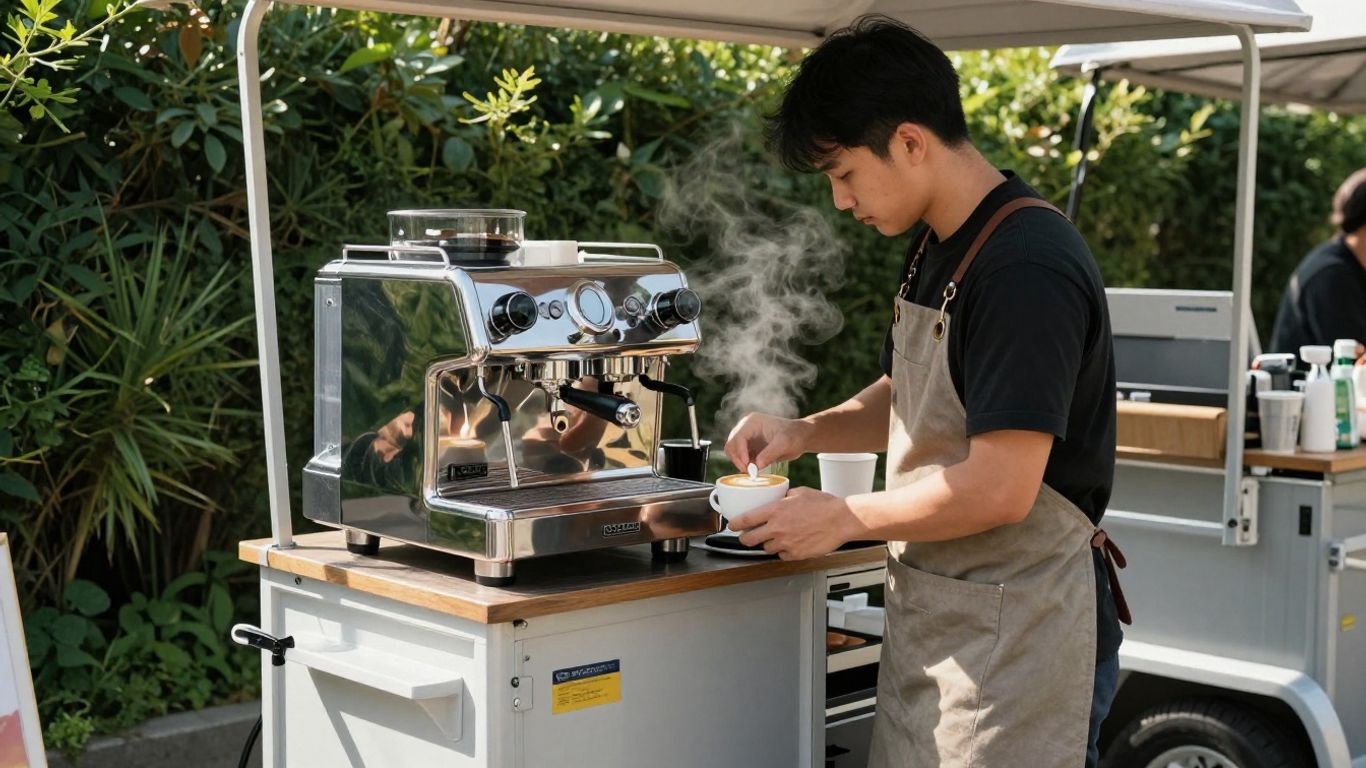
Getting your coffee machine to work when you’re out and about is a big part of the puzzle. You can’t just plug into the mains like a shop. So, what are your options?
Understanding Generator Requirements
Generators are a common choice for mobile catering. They give you the power you need, wherever you are. But, it’s not as simple as just buying any old generator.
-
Check your machine’s wattage: Your coffee machine, especially an espresso one, can use a lot of power. Look at the machine’s label or manual for its power draw (in watts).
-
Add up all your equipment: Don’t forget grinders, fridges, lights, and any payment systems. Add their wattage to your coffee machine’s needs.
-
Factor in a buffer: It’s wise to have a generator that’s at least 20% more powerful than your total calculated need. This stops it from being overworked.
-
Consider noise levels: Some generators can be very loud. Check local rules or event restrictions on noise. Look for ‘inverter’ generators; they’re usually quieter and more fuel-efficient.
A reliable generator is key to consistent service.
Exploring LPG Coffee Machine Options
Liquefied Petroleum Gas (LPG) powered coffee machines offer an alternative to electric ones, especially if you’re worried about generator noise or fuel costs.
-
How they work: These machines use LPG (like propane) to heat water, often with a built-in electric pump for pressure. They’re great for making espresso-based drinks.
-
Benefits: They can be more cost-effective to run than electric machines, especially if you’re using a generator. They also tend to be quieter.
-
Safety first: You’ll need to store LPG cylinders safely and securely. Make sure they’re upright and away from heat sources. Always check connections for leaks.
-
Availability: LPG is widely available, but you’ll need to plan for refills or swaps.
LPG machines can be a smart move for reducing running costs and noise pollution, but safe storage and handling of gas cylinders are non-negotiable.
Assessing Water and Waste Management
Power is one thing, but you also need water to make coffee and a place to put the used stuff.
-
Water supply: Most mobile coffee machines need a direct water connection. You’ll need onboard water tanks and a pump system. Check how much water your machine uses per hour and how much you’ll need for a typical day.
-
Water quality: Use a good water filter. This protects your machine from limescale and makes your coffee taste better. Impurities in water can really affect the flavour.
-
Waste water: You’ll need a separate tank for waste water from rinsing cups and the machine. Check local rules on how to dispose of this responsibly – you can’t just pour it down a drain.
-
Waste bin: Have a clearly marked bin for used coffee grounds and other waste. Empty it regularly.
Essential Considerations Beyond the Coffee Machine
Reliable Water Filtration Systems
Good coffee starts with good water. Impurities in your water supply can really mess with the taste of your coffee. Think chlorine or minerals – they can make your brew taste off and even damage your coffee machine over time. A decent water filter is a must-have. It cleans up the water, making your coffee taste better and helping your kit last longer. It’s a small thing that makes a big difference.
Choosing the Right Grinder
Freshly ground coffee beans are key for a great cup. A good grinder makes sure your coffee is consistent and flavourful. For espresso, you need a fine grind. For filter coffee, a coarser grind works best. A quality burr grinder is usually the way to go, as it gives you a uniform grind size. This means better flavour extraction, every single time. Don’t skimp here; it’s a vital part of the process.
Selecting Appropriate Supplies and Accessories
Beyond the main machine, think about the bits and bobs that keep things running smoothly. This includes things like:
-
Milk frothing jugs: For getting that perfect texture for lattes and cappuccinos.
-
Tampers: To pack the coffee grounds evenly in the portafilter.
-
Cleaning brushes: To keep your grinder and steam wand spotless.
-
Knock boxes: For easily disposing of used coffee grounds.
-
Storage containers: Airtight ones are best for keeping coffee beans fresh.
Having these handy means you can work faster and keep your equipment in good nick. It also helps maintain hygiene, which is always a plus.
Keeping your workspace tidy and organised is just as important as the coffee itself. A clean setup not only looks professional but also helps prevent cross-contamination and ensures a smoother workflow during busy periods. Think about where you’ll store everything, from spare cups to cleaning supplies, so it’s all within easy reach.
Maintenance and Support for Your Coffee Machine
Routine Cleaning and Servicing
Keeping your machine clean is non-negotiable. Daily wipes down of surfaces, steam wands, and portafilters prevent build-up. A deeper clean, including descaling, should happen weekly or bi-weekly, depending on water hardness and usage. Regular servicing by a qualified technician prevents costly breakdowns. Check your machine’s manual for specific cleaning schedules and recommended products. For example, using a dedicated espresso machine cleaner removes coffee oils and mineral deposits that affect taste and machine health.
Troubleshooting Common Issues
Many common problems have simple fixes. “No water” might mean a blocked pipe or an empty water tank. “Weak coffee” could be due to old beans, incorrect grind size, or a need for descaling. “Machine not heating” often points to a thermostat issue or a heating element problem. Always consult your machine’s manual first. If you’re unsure, don’t guess – it could cause more damage.
Finding Reputable Repair Services
When a problem can’t be fixed easily, you need a reliable repair service. Ask other mobile caterers for recommendations. Look for engineers who specialise in commercial coffee machines and have good reviews. Having a service contract can offer peace of mind and faster response times. Keep the contact details of your chosen service provider handy for emergencies.
Making Your Final Choice
So, you’ve looked at the different coffee machines out there for your mobile catering business. It’s a big decision, and honestly, there’s no single ‘best’ option for everyone. Think about what you’ll be serving most – quick espressos for a busy market, or maybe larger batches of filter coffee for events? Your budget, the space you have, and even how much time you have to spend on maintenance all play a part. Don’t forget to factor in reliability; you don’t want your machine breaking down when you’ve got a queue of customers. Take your time, do your research, and choose the machine that feels right for your specific setup. Getting this bit right means better coffee for your customers and a smoother operation for you.
Frequently Asked Questions
What is the most important thing to consider when picking a coffee machine for my mobile catering business?
The most crucial factor is understanding your specific business needs. Think about how many customers you usually serve and the types of coffee drinks you plan to offer. Also, consider the space you have available in your vehicle and the power sources you can rely on, whether it’s a generator or a mains connection.
How do I choose a coffee machine that can handle a busy service?
For busy periods, you’ll want a machine with a good brewing capacity and speed. Espresso machines designed for commercial use are often a good choice as they can produce multiple drinks quickly. Look for models known for their durability and ability to withstand frequent use.
Are LPG coffee machines a good option for mobile catering?
Yes, LPG coffee machines are very popular for mobile catering, especially when you don’t have easy access to mains electricity. They are efficient and reliable, allowing you to operate independently. MobCater specialises in these, offering solutions that meet UK regulations.
What kind of power supply do I need for a commercial coffee machine?
This depends on the machine. Some smaller machines might run on standard generators, but larger, more powerful espresso machines often require a generator with a higher wattage output. It’s essential to check the machine’s power requirements and ensure your generator can meet them safely.
Besides the coffee machine, what other equipment is important for a mobile coffee setup?
You’ll definitely need a good quality coffee grinder to ensure fresh grounds, as this significantly impacts taste. A reliable water filtration system is also vital for both coffee quality and machine longevity. Don’t forget essential supplies like cups, lids, and milk.
How often should I clean and maintain my mobile coffee machine?
Regular cleaning is key to keeping your machine working well and your coffee tasting great. Daily cleaning should involve rinsing parts and wiping down surfaces. Deeper cleaning and descaling should be done weekly or as recommended by the manufacturer. Consistent maintenance prevents costly breakdowns.